Source: YouTube captions. Brand spellings and clearly missing decimal points have been corrected against the published description. The original English wording is retained; use the video to confirm any passage.
0:00 I helped build an automated trading strategy. Its simulated results were positive. But in my own account, I was losing money. The hardest part to admit,
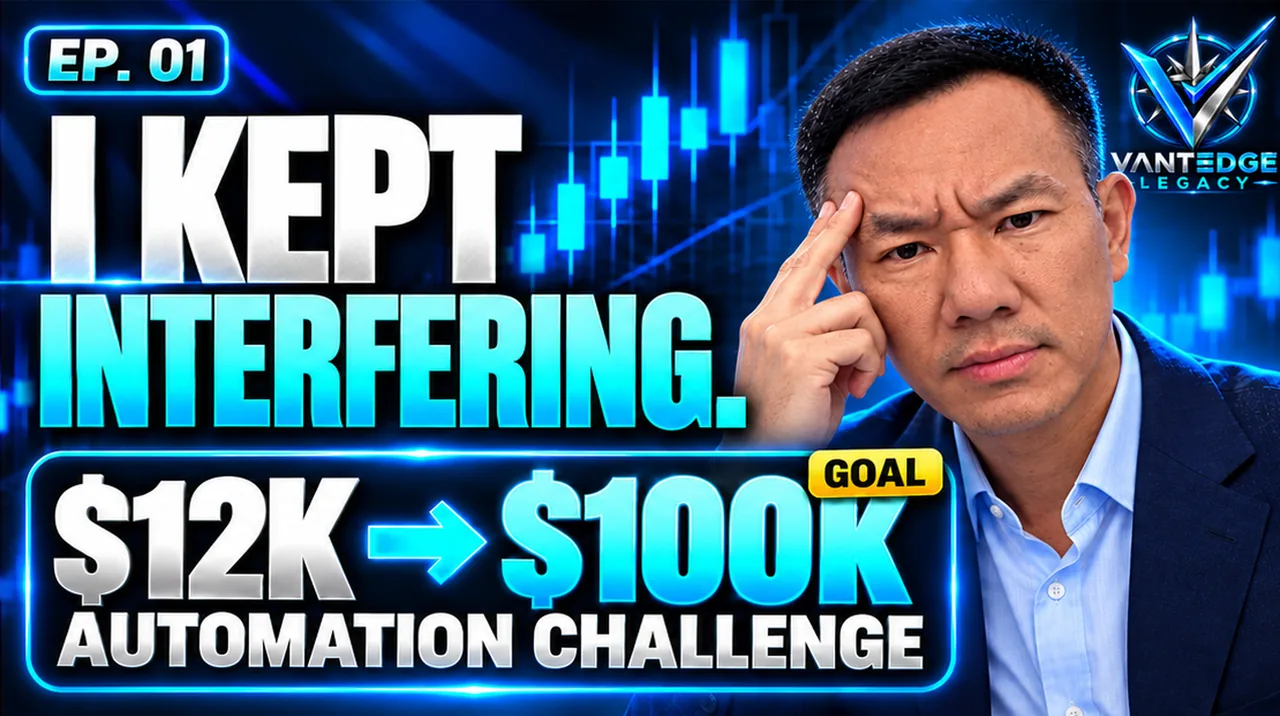
0:08 I kept interfering. I closed trades early. I secondguess signals. I paused the automation. And after losses, I
0:15 sometimes revenge traded, taking extra trades to try to win the money back. I also kept chasing something better. When one strategy had a bad stretch, I moved
0:24 to another, then another. Each time I told myself this one would be different.
0:28 But switching strategies didn't fix my inconsistent execution. My own decisions were part of the problem. I'm Tony. I have left vocal cord paralysis, which
0:38 makes speaking smoothly difficult. So, I'm sharing this story through my AI generated digital twin. The experience and the words are mine. I also want to
0:46 be upfront about my connection to Trenova. I'm an employee on the development team at VantEdge Legacy, a family-owned business where I help build Trenova MNQ, an automated future strategy.
0:57 I don't receive additional compensation tied to sales, but I do work for the company. This is not an independent review. At the beginning of September
1:05 2026, I started using Trenova for live trading. Entries were automated through Pick My Trade, but I managed most exits
1:12 manually. I sometimes paused the automation and place separate discretionary trades. I overtraded, I revenge traded, and I lost money. So,
1:20 when I say my account was losing money while the simulated results were positive, those are two different records. My account reflected a mixture
1:27 of automated entries, manual exits, missed signals, and my own trades. I haven't reconciled those broker records well enough to report a verified Trenova
1:36 only live result, and I can't claim that leaving the automation alone would have produced the back test results. Trenova's published back test covers 36 months,
1:44 October 2023 through September 2026 on one MNQ contract. It shows about $56,000
1:52 in hypothetical net profit, a maximum draw down of about $1,900, a longest losing streak of nine trades, and a
2:00 worst day of about $750. The test included modeled commissions, and used a $25,000 starting account. The draw down figure includes swings and open trades.
2:10 Those are simulated numbers, not money earned in my account. The strategy was developed using historical data and real trading can differ because of slippage, fills, fees, and changing markets.
2:21 Future losses could be larger than anything shown. Treat those numbers as background. What I want you to follow is the actual account record. The full back
2:29 test report, including detailed results, testing assumptions, and disclosures, is linked in the description below. So,
2:36 today I'm starting a new chapter. I'm dedicating my personal IRA to this challenge with a starting balance of exactly $12,390.42.
2:47 Welcome to episode one of the VantEdge Legacy $12,000 to $100,000 automation challenge. The question is simple. Can I
2:55 grow this account toward $100,000 while following one automated strategy with discipline? I don't know. $100,000 is a
3:03 goal, not a forecast. There's no promised timeline and I could lose most or all of this account. This is part of my retirement savings, so those losses
3:11 would be personal. Here's the plan. One MNQ contract with Trenova managing entries and exits according to its programmed rules using preset stop-loss
3:20 and take-profit orders. No discretionary trades, no chasing losses, no switching strategies in response to a bad stretch.
3:27 I'm not adding a daily loss limit of my own. I'm disclosing that, not recommending it. And a preset stop doesn't guarantee an exact exit price or
3:35 a ceiling on losses. My commitment is simple. Trenova handles every entry and exit. And I'll keep monitoring the system. I'll step in for only two
3:44 reasons. A technical problem that requires intervention or the account falling below what's required to keep trading 1 MNQ contract. If either
3:51 happens, I'll document exactly what happened and why. If I ever change this policy, I'll disclose it in the next weekly recap with the date and my
3:59 reasoning. As of today, full entry and exit automation is enabled through Pick My Trade, and Trenova is managing both sides of each trade. I know how it
4:07 sounds to say, "I'm committing to one strategy." Again, that's why this needs to be more than a promise. It needs a record. Every week, I'll share the live
4:15 signals alongside the actual broker confirmed trades. If a signal doesn't become a trade or an exit differs from the strategy, I'll make that clear. I'll
4:23 show the profits, losses, and draw downs. Deposits and withdrawals will be labeled so they aren't confused with trading performance and the simulated
4:31 results and my live results will stay separate. You'll see the good weeks and the bad weeks. If the strategy struggles or I failed to follow the plan, that
4:39 belongs in the story, too. This is my personal IRA, not a company managed account. I'm documenting my experience, not giving investment advice or asking
4:48 anyone to copy my trades. Futures trading carries substantial risk. Past results, actual or simulated, don't guarantee future performance. If you
4:57 want to follow a personal account of automation, discipline, and real trading results, subscribe to VantEdge Legacy for the weekly recap. I helped build it.
5:06 Now, I'm committing to follow the plan and show you what actually happens. $12,390.42.
5:13 One ambitious goal, an uncertain outcome. The journey starts today.